VPC to VPC Networking Solutions:
Simplify Multi-Cloud Connectivity

Connect your VPCs - across accounts, regions, clouds - without subnet collisions, VPN overhead, or public exposure.

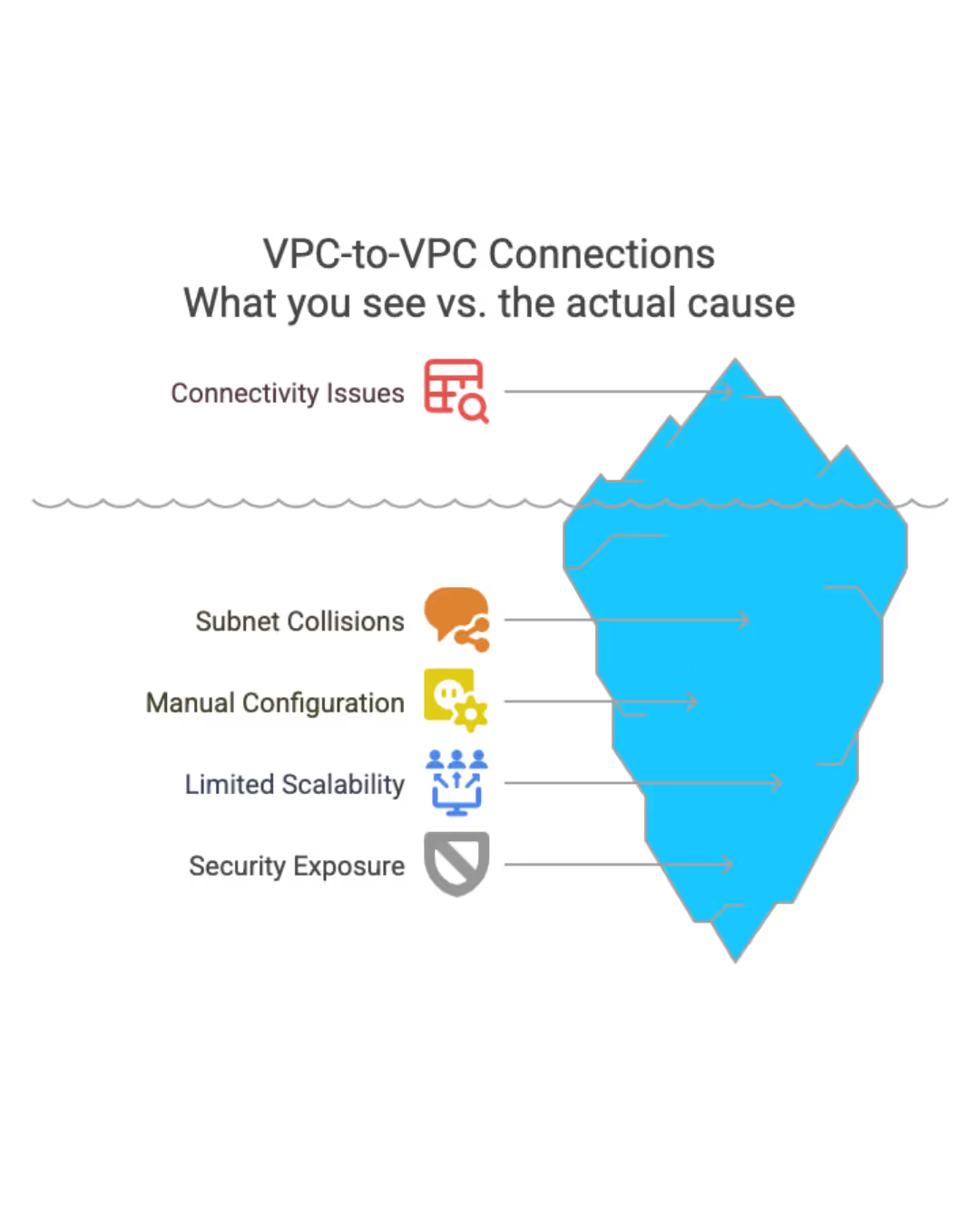
The problem: VPC-to-VPC connections are a mess

If you've tried to connect two VPCs, you've likely run into VPC networking challenges:
  • Subnet collisions due to overlapping CIDRs
  • Manual configuration nightmares with VPN tunnels, routing tables, and NAT gateways
  • Limited scalability across accounts or regions
  • Security exposure from requiring public IPs or public routing
  • Hours (or days) of DevOps time spent debugging connectivity issues
VPN connections: Cause and Effect graphic
I understand VPCs - Skip to the good stuff

What is a VPC (Virtual Private Cloud)?

A Virtual Private Cloud (VPC) is an isolated virtual network environment within a public cloud provider's infrastructure that gives you complete control over your network configuration. Think of it as your own private section of the cloud where you can launch resources in a logically separated environment that you define.

VPC Core Components

Network Isolation: VPCs create a boundary around your cloud resources, separating them from other customers' resources and the public internet. This isolation is achieved through software-defined networking that mimics having your own physical data center.

IP Address Management: Each VPC comes with its own private IP address space that you define using CIDR blocks (e.g., 10.0.0.0/16). You have complete control over IP addressing, subnetting, and network topology within this space.

Virtual Networking Controls: VPCs provide networking features including subnets, route tables, internet gateways, NAT gateways, and security groups that control traffic flow and access to your resources.

How VPCs Work Across Cloud Providers

Amazon Web Services (AWS VPC):AWS VPC allows you to provision a logically isolated section of Amazon's cloud where you can launch resources in a virtual network you define. You control network configuration including IP address ranges, creation of subnets, and configuration of route tables and network gateways.

Microsoft Azure Virtual Network (VNet):Azure VNet provides similar functionality to AWS VPC, enabling you to create isolated network environments within Azure. VNets support hybrid connectivity scenarios through VPN gateways and ExpressRoute connections.

Google Cloud Platform (VPC Network):Google Cloud VPC networks are global resources that provide connectivity for your cloud resources. Unlike AWS and Azure, Google's VPC networks are not bound to specific regions and can span multiple geographic locations.

Common VPC Use Cases

Multi-Tier Application Architecture: Deploy web servers in public subnets with internet access while keeping database servers in private subnets without direct internet connectivity.

Hybrid Cloud Connectivity: Connect your on-premises infrastructure to cloud resources through VPN connections or dedicated network links, extending your data center into the cloud.

Development Environment Isolation: Create separate VPCs for development, staging, and production environments to ensure complete isolation and different security policies.

Compliance and Security Requirements: Meet regulatory requirements by implementing network-level isolation and controlling data flow between different application components.

VPC Networking Fundamentals

Subnets and Availability Zones: VPCs are divided into subnets that can be public (with internet gateway access) or private (without direct internet access). Subnets are typically mapped to specific availability zones for high availability.

Route Tables: Control where network traffic is directed within your VPC and to external networks. Each subnet is associated with a route table that determines traffic flow.

Security Groups and NACLs: Provide stateful (security groups) and stateless (Network Access Control Lists) firewall capabilities to control inbound and outbound traffic at the instance and subnet levels.

Internet and NAT Gateways: Enable controlled internet access for resources within your VPC. Internet gateways provide direct internet access to public subnets, while NAT gateways allow private subnet resources to access the internet without being directly reachable from it.

VPC Connectivity Patterns

VPC Peering: Direct network connection between two VPCs, allowing resources in different VPCs to communicate as if they were on the same network. Limited to same cloud provider and often same region.

Transit Gateway/Hub: Centralized connectivity hub that connects multiple VPCs and on-premises networks through a single gateway, simplifying network architecture.

Site-to-Site VPN: Encrypted connection between your VPC and on-premises network over the public internet, extending your network into the cloud.

Direct Connect/ExpressRoute: Dedicated network connection between your premises and cloud provider, bypassing the public internet for more consistent performance and enhanced security.

VPC Limitations and Challenges

Cross-Cloud Complexity: VPCs are cloud provider-specific, making multi-cloud networking complex and requiring separate configurations for each platform.

IP Address Conflicts: When connecting multiple VPCs or hybrid environments, overlapping IP address ranges create routing conflicts that require complex NAT configurations or network redesign.

Routing Table Management: As networks grow, route table management becomes complex, especially when connecting multiple VPCs and on-premises networks.

Limited Cross-Region Connectivity: VPC peering and networking features often have regional limitations, requiring additional complexity for global applications.

Manual Configuration Overhead: Setting up secure, scalable VPC networking requires deep networking expertise and significant manual configuration.

Modern VPC Evolution

Traditional VPC networking was designed for single-cloud, single-region deployments but modern applications require:

  • Multi-cloud connectivity without vendor lock-in
  • Automatic conflict resolution for overlapping networks
  • Policy-driven networking instead of manual route management
  • Zero-trust security built into the network layer
  • Simplified operations for distributed teams

Understanding these VPC fundamentals helps explain why organizations increasingly need networking solutions that can operate above the cloud provider layer, providing consistent connectivity and security policies across any infrastructure.
The noBGP solution: effortless, secure, scalable connections

noBGP makes VPC-to-VPC networking instant, private, and programmable:
  • No subnet coordination - eliminate IP overlaps issues without changing your existing VPC CIDRs
  • No VPNs or NAT gateways - fully private connectivity without exposing your infrastructure
  • Multi-cloud, multi-region ready - connect any VPCs, from any cloud, anwhere
  • Infrastructure as code - deploy with a few lines of code as you deploy compute and storage resources
  • Security by design - no public IPs, no attack surface

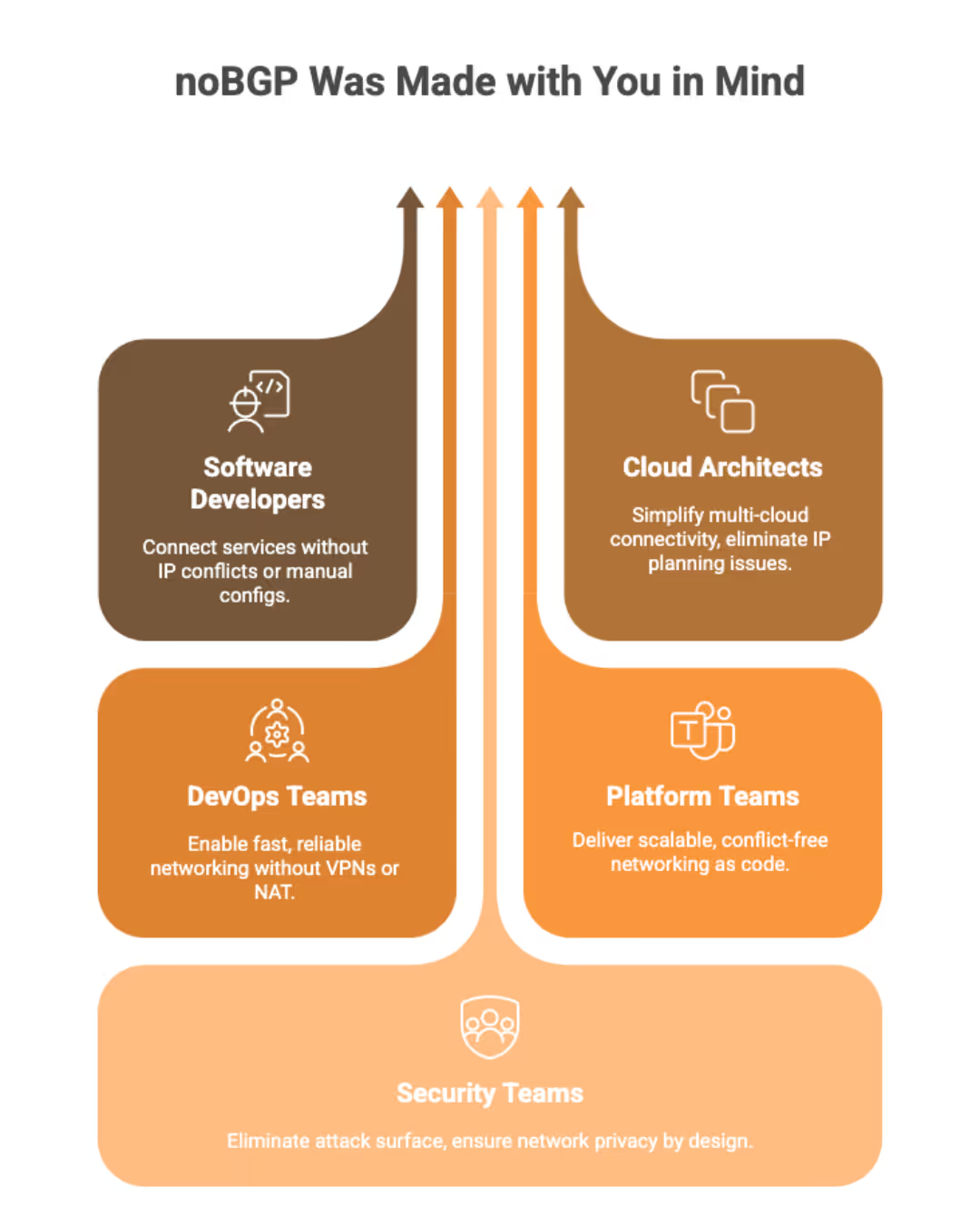
Who it's for

noBGP makes everyone's lives simpler and more secure.
  • Software Developers connect services across environments without worrying about IP conflicts, subnet overlaps, or manual network configs.
  • Cloud architects simplify multi-cloud connectivity by eliminating IP planning and overlapping subnet issues.
  • DevOps teams enable fast, reliable service-to-service networking without the need for VPNs, NAT rules, or port forwarding.
  • Platform teams deliver scalable, conflict-free networking as code, so environments stay reproducible and secure.
  • CISOs and IT security teams eliminate attack surface. No public IPs, no exposed ports. Network privacy by design.
Job roles that benefit from noBGP

How noBGP compares to traditional networking solutions

When evaluating VPC connectivity options, organizations typically consider several approaches. Here's how noBGP stacks up against the most common alternatives:

noBGP vs. VPC Peering

VPC Peering creates a direct network connection between two VPCs, but comes with significant limitations:
  • CIDR conflicts: Peering fails if VPCs have overlapping IP ranges, forcing you to redesign your network architecture.
  • Limited scalability: Each peering connection is point-to-point, creating a mesh complexity that becomes unmanageable with multiple VPCs.
  • Single-cloud limitation: Most cloud providers only support peering within their own ecosystem.
  • No transitive routing: VPC A cannot reach VPC C through VPC B, requireing multiple direct connections.
noBGP advantages: Works with overlapping CIDRs, scales to hundreds of VPCs, support multi-cloud environments, and enables transitive connectivity through a unified network overlay.

noBGP vs. Transit Gateway

Transit Gateway (AWS) acts as a central hub for connecting multiple VPCs and on-premises networks:
  • Still requires CIDR coordination: Overlapping IP ranges cause routing conflicts.
  • Cloud vendor lock-in: Each cloud provider has their own version (Azure VirtualWAN, GCP Network Connectivity Center).
  • Complex routing management: Route tables and propagation rules become difficult to manage at scale.
  • Regional limitations: Cross-region connectivity requires additional configuration and costs.
noBGP advantages: Eliminates IP planning requirements, works across any cloud provider, simplified routing with automatic path optimization, and provides seamless global connectivity.

noBGP vs. AWS PrivateLink

PrivateLink enables private connectivity to services without exposing traffic to the public internet:
  • Service-specific: Designed for connecting to specific services, not general VPC-to-VPC communication.
  • One-way connectivity: Typically allows access to services but not bidirectional network communication.
  • AWS-centric: While other clouds have similar services, they're not interoperable.
  • Limited to specific use cases: Great for accessing managed services privately, but doesn't solve general networking challenges.
noBGP advantages: Provides full bidirectional network connectivity, works for any application or service, enables true multi-cloud architecture, and supports complex network topologies.

noBGP vs. Traditional VPN Solutions

VPN Tunnels have been the go-to solution for private connectivity across networks:
  • Management overhead: Requires configuration and maintenance of VPN gateways, tunnels, and routing.
  • Performance bottlenecks: VPN gateways can become bandwidth and latency bottlenecks.
  • High availability complexity: Setting up redundant VPN connections requires careful planning and additional costs.
  • Public IP dependency: Most VPN solutions require public IP addresses, increasing attack surface.
  • Manual scaling: Adding new connections requires manual configuration and coordination.
noBGP advantages: Zero gateway management, optimized performance with automatic path selection, built-in redundancy and failover, no public IP requirements, and automatic scaling as you add new VPCs.

The noBGP difference

Unlike traditional approaches that work at the infrastructure level, noBGP creates an intelligent private network that sits above your existing VPC infrastructure. noBGP's revolutionary solutions enables:
  • No infrastructure changes: Your existing VPCs, subnets, and security groups remain unchanged.
  • Automatic IP translation: Applications use their original IP addresses while noBGP handles routing between overlapping networks.
  • Intelligent routing: Traffic automatically takes the optimal path based on your criteria, not BGP's best effort. Route based on latency, throughput, cost, availability, security, network sovereignty, and compliance.
  • Universal compatibility: Works with any cloud provider, region, or on-premises environment.

When to choose each solution

  • Choose VPC Peering when: You have 2-3 VPCs in the same cloud provider with non-overlapping CIDRs and simple connectivity requirements.
  • Choose Transit Gateway when: You're heavily invested in a single cloud ecosystem and can coordinate IP addressing across all VPCs.
  • Choose PrivateLink when: You need private access to specific managed services rather than general network connectivity.
  • Choose traditional VPN when: You're connecting to legacy systems that require standard IPSec protocols.
  • Choose noBGP when: You want the simplest, most scalable solution that works across any environment without architectural constraints.

Frequently Asked Questions

What cloud providers does noBGP support?

noBGP works with all cloud and data center providers including AWS, Azure, GCP, Oracle, Cachengo, Equinix, and more. There is no technology lock-in to specific vendors. Migrate your workloads to any location including on-premise environments.

Does noBGP replace my VPN?

Yes, noBGP creates private, encrypted connections without the complexity of VPN tunnels.

Do I need to reconfigure my VPCs?

No. You can keep your existing CIDR blocks - even overlapping ones.

How is this different from VPC Peering?

VPC Peering requires CIDR coordination and doesn't scale well. noBGP works even with overlapping IP ranges and simplifies operations. noBGP also works across accounts within a cloud provider or across multiple cloud providers.

Reinventing networking to be simple, secure, and private.
Register your free account now